Skip to content
Expatriation-Maurice
Which visa or permit is right for you?

Free, 2 minutes, instant result.

Take the quiz
Free call-back request
Early childhood·Mauritius

Nurseries and day care in Mauritius

From what age, at what price, with how many adults per child, and what the law requires of a nursery. Then pre-primary for ages 3 to 5, and French-language kindergarten.

Updated 10 November 2026

A childcare assistant plays with wooden blocks with three toddlers in the bright playroom of a nursery (illustrative image)
1 adult for 6between 1 and 2 years old, by law
  • 14 weeksthe minimum age to start nursery
  • 1 for 4one adult for 4 babies under one year old
  • 3 yearsthe start of pre-primary, up to age 5
  • 403expatriate children in pre-primary in March 2026
By age

Which type of childcare for your child?

Tap your child's age and what matters to you: the options that match come first.

A couple with their baby in their arms visit a nursery's sleeping room with the director (illustrative image) From 14 weeks to 3 years

The most closely regulated option for toddlers

The nurseryA framework set by law since 2022

In Mauritius, a nursery is called a Child Day Care Centre. Since 24 January 2022, a set of regulations covers everything: the age of admission, the number of adults per child, space, opening hours, the paediatrician's visit. No nursery can open without being registered, and the certificate must be displayed at the entrance. That is the first thing to check.

Age
14 weeks to 3 years
Who inspects
The Ministry of Gender Equality
The price
Rs 4,000 to 9,000 (about $85 to $190) a month, according to the Expat.com guide
The right habit
The right habit
Its strengths and what to know

Its strengths

  • One adult for 4 babies under one year old, for 6 children aged 1 to 2, for 10 children aged 2 to 3
  • Open during the school holidays, as required by law
  • Parents may come in during opening hours

Good to know

  • No child under 14 weeks is accepted
  • The registration certificate is valid for 3 years, then must be renewed
  • The price appears in no legal text: ask for the fee schedule and the registration fees

Two children with their bags in a school corridor, beneath drawings pinned to the wall From 3 to 5 years

A different authority, a different calendar

Pre-primaryMauritian nursery school, before school at age 5

At 3, your child leaves the crèche for a pre-primary school. It is no longer the same ministry: the Early Childhood Care and Education Authority registers these schools and their educators. At 5, your child starts Mauritian primary school, which begins in January.

Age
3 to 5 years
Who inspects
The ECCEA, under the Ministry of Education
The price
Free or partly paid for by the State, depending on the school
The right habit
Ask whether your child is eligible
Its strengths and what to know

Its strengths

  • Pre-primary has been free since 2024 in schools that have joined the public scheme
  • 403 expatriate children were enrolled in March 2026, according to Statistics Mauritius

Good to know

  • A reform announced in late 2025 pays the school Rs 2,750 (about $59) per child per month, with the rest paid by parents
  • We have not read any rule about foreign children: the school will tell you whether yours is eligible
  • Pre-primary is not compulsory; school is from age 5
A French couple and their two children, backpacks on, welcomed by a Mauritian teacher in front of a school surrounded by palm trees From age 3

The start of term in late August

A French-language nursery schoolTo keep in step with the French school system

If your child needs to follow the French curriculum, the question has to be settled from age 3. École du Nord, Paul et Virginie and École du Centre take children from petite section, La Bourdonnais from grande section. Saint-Exupéry, in Grand Baie, is bilingual French-English from age 3, though it is not homologated. Places need to be requested early.

Age
From petite section
Who inspects
Homologation by France
The price
See our guide to French schools
The right habit
Enrol before choosing your neighbourhood
Its strengths and what to know

Its strengths

Good to know

  • There are waiting lists at École du Nord
  • French schools require your child to be listed on your residence permit
Two children with their school bags walking towards an international school in Mauritius From a few months old

Crèche and school in the same place

An English-language schoolSome take babies

A few international schools open their doors well before age 3. Dukesbridge, in Moka, Curepipe and Quatre Bornes, takes children from 3 or 6 months depending on the site. Northfields takes children from 18 months. Your child then stays on at the same school, in English. It is convenient, but it means choosing a language for the whole of their schooling.

Age
From 3 or 6 months at Dukesbridge, 18 months at Northfields
Who inspects
The crèche follows the same regulations as the others
The price
Ask the school
The right habit
Think about later studies
Its strengths and what to know

Its strengths

Good to know

  • English-language schools mostly follow a January calendar
  • Moving back to a French school means preparing ahead for written French
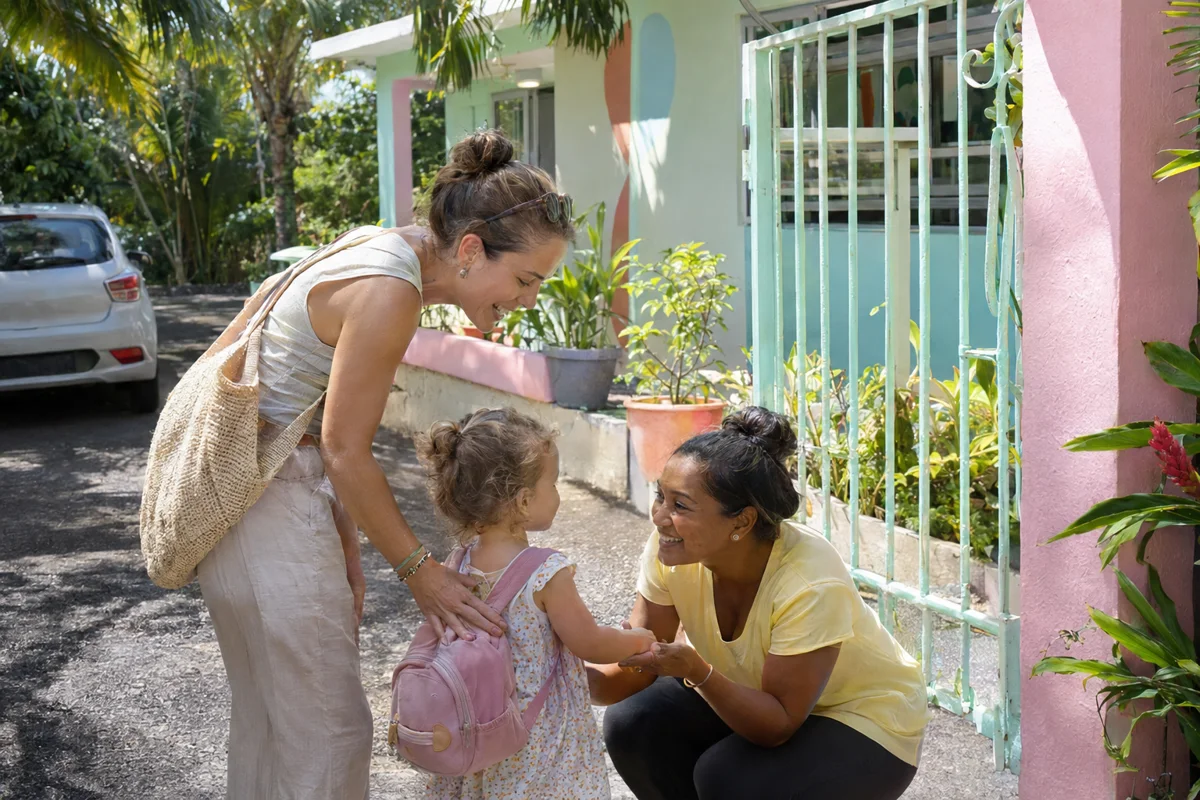
A mother entrusts her little girl to a childcare worker crouching down to her level, in front of the gate of a small nursery (illustrative image) At home or in the neighbourhood

Common, and less regulated

A nanny or a micro-nurseryFlexibility, with more checks to make

The Expat.com guide describes independent micro-nurseries, mostly in the west, taking 4 to 8 children for half-days, and home nannies that are common but lightly regulated. Be careful: under the law, a nursery, a crèche or any organised setting that looks after children under 3 must be registered.

Age
All ages
Who inspects
You, for a nanny in your home
The price
Negotiable
The right habit
References and a certificate of character
Its strengths and what to know

Its strengths

  • Hours that follow yours
  • A sick child can stay at home

Good to know

  • A small setting must show its registration certificate, just like a large one
  • The regulations require nursery staff to hold a certificate of character less than 3 months old: it is a good baseline for a nanny too
The 2022 regulations

What the law requires of a nursery

The Child Day Care Centres Regulations, in force since 24 January 2022, apply to any crèche, day care centre or nursery that takes children from 14 weeks to 3 years old.

The ruleThe legal minimumCan be seen during the visit
The registration certificateDisplayed at all times, valid for 3 yearsCompulsory Yes
One adult for 4 babiesBetween 14 weeks and 1 year1 for 4 Yes
One adult for 6 childrenBetween 1 and 2 years1 for 6 Yes
One adult for 10 childrenBetween 2 and 3 years1 for 10 Yes
Indoor spaceFor play and sleep, excluding corridors and kitchen3.25 m² per child Yes
Outdoor spaceExcluding buildings7 m² per child Yes
One cot per babyUnder 2 years; one bed for 2 children aged 2 to 3One each Yes
Opening hoursMonday to Saturday, school holidays included6 h à 18 h 30 Yes
Visit by a paediatrician and a dentistAnd a doctor who can be reached in an emergencyEvery 4 months
The staff evacuation drillRecorded in writingEvery 3 months
Liability insuranceFor the care given to childrenCompulsory
Employees' certificate of good characterLess than 3 months old at hiring, with a medical certificateCompulsory

Regulations published in Government Notice No. 29 of 2022, made under the Children's Act 2020, read on 10 November 2026. An offence is punishable by a fine of up to Rs 200,000 (about $4,300) and up to 5 years in prison.

Budget and calendar

Four pointers to help you plan

Nursery fees are not regulated. What is fixed is the opening hours and the public aid for pre-primary.

about $85 to $190 per month

The nursery

That is Rs 4,000 to 9,000 (about $85 to $190): the range given by the 2026 Expat.com guide, depending on region and age, with registration fees on top. The same guide quotes about Rs 6,000 (about $130) a month for a full day.

6 h à 18 h 30 Monday to Saturday

Opening hours

This is the window set by law. In practice, most nurseries open from 7.30am to 5pm, according to the Expat.com guide. On Sundays, it is up to the nursery.

about $59 per child per month

Pre-primary

That is Rs 2,750 (about $59), the amount paid to the school by the State, under the reform announced at the end of 2025 by Defimedia. Parents pay the difference with the school's fee.

January or late August

The school year starts

Mauritian schools and many English-speaking schools start in January, French schools in late August. The nursery, for its part, stays open during school holidays.

The path

From nursery to school

Three stages, two different authorities, and a choice of language to make fairly early.

  1. 1

    The nursery

    From 14 weeks to 3 years. The Ministry of Gender Equality and Family Welfare registers nurseries and their staff.

    14 weeks
  2. 2

    Pre-primary

    From 3 to 5 years. The Early Childhood Care and Education Authority registers the schools. On the French side, this is the petite section.

    3 years
  3. 3

    Primary school

    Compulsory from age 5. Start in January at Mauritian schools, late August at French schools.

    5 years
Before enrolling

Four checks during the visit

A twenty-minute visit is enough to see the essentials, if you know what to look for.

  • The certificate. It must be displayed, along with the opening hours, the evacuation procedure and the complaints procedure. Check the date: it is valid for 3 years.
  • The number of adults. Count them in the room with children of your child's age: 1 for 4 under one year, 1 for 6 up to 2 years, 1 for 10 up to 3 years.
  • Your child's documents. Birth certificate and health and vaccination record: the nursery must keep a copy. Have them ready before you go.
  • Health. Ask for the name of the doctor who can be reached in an emergency and the date of the paediatrician's last visit. The law requires one every 4 months.

Your children on your permit

A young couple and their baby hand documents to a clerk at an office counter (illustrative image)
Frequently asked questions

Nurseries in Mauritius: your questions

From 14 weeks, a little over 3 months. Nursery regulations forbid enrolling a younger child. The nursery then takes the child until the age of 3, when pre-primary begins.

The 2026 Expat.com guide gives Rs 4,000 to 9,000 (about $85 to $190) a month depending on the region and the child's age, plus a registration fee. There is no official tariff: ask for the full fee schedule, with meals and extra hours included, before you commit.

Every nursery must be registered and must display its registration certificate at all times, along with its opening hours, its evacuation procedure and how it handles parents' complaints. A missing or expired certificate is a warning sign. The certificate is valid for 3 years.

The 2022 regulations set one adult for 4 babies under 1, one for 6 children aged 1 to 2 and one for 10 children aged 2 to 3. Count the adults present during your visit, at a time when the children are there.

The law sets the opening window from Monday to Saturday, 6am to 6.30pm, and requires nurseries to open during school holidays. According to the Expat.com guide, most open in practice from 7.30am to 5pm, some until 6pm. An earlier closure must be announced 24 hours in advance.

Pre-primary, for ages 3 to 5, has been free since 2024 in schools that have joined the public scheme. A reform announced at the end of 2025 pays the school Rs 2,750 (about $59) per child per month, with parents paying the difference. We have not read any rule for foreign children: ask the school.

Mauritian primary school starts at 5, and school is compulsory until 16. The school year begins in January. French schools follow the French calendar, with a start at the end of August: 28 August in 2026.

Nothing fixes the language of a nursery: ask during the visit which one is spoken with the children. For schooling in French afterwards, accredited schools take children from the first year of nursery school (petite section), and Saint-Exupéry is bilingual from age 3. See our guide to French schools.

The regulations require the nursery to keep a copy of the child's birth certificate and of their health and vaccination record. Have them ready before you leave. The regulations say nothing about the residence permit; French schools, however, ask for it from nursery school onwards.

A nursery is inspected: ratios, space, a paediatrician every 4 months. A nanny follows your hours, but nobody checks her on your behalf. Ask for references and a recent certificate of character, and do a trial of a few days.

Yes. Your children are added to your residence permit as dependants. Remember to include them from the start: schools ask for this at enrolment. See the Residence Permit for dependants.

Advisers available
Ready to take the plunge?
  • Free
  • No obligation
  • French-speaking advisers
Request a free call back
Our guides

More guides

Read in November 2026: Child Day Care Centres Regulations 2022 (Government Notice No. 29 of 2022, Ministry of Gender Equality website), the Early Childhood Care and Education Authority website, Statistics Mauritius (education, March 2026), mega.mu (18 October 2023), Defimedia (end of 2025), the Dukesbridge, Northfields and Saint-Exupéry websites, Expat.com guide (2026). We do not recommend any nursery in particular: we did not visit any for this page. The images are illustrations only: they do not show any real nursery.