+33 9 8080 1114
 +230 5457 0712

The essentials in 30 seconds
- Two laws, published on 13 August 2026: the Finance Act 2026 for taxes, and a second law that amends the Immigration Act and the permits.
- Stricter permits: investor at $100,000 only, employee from Rs 50,000 (about $1,100) a month, self-employed with new thresholds. The family permit disappears.
- The retirement permit does not change: $2,000 then $24,000 a year, like the Permanent Residence Permit and the Premium Visa.
- Good news for buyers: the rise in duty to 10% is cancelled; it stays at 5%.
- Tax: a 35% band above Rs 12 million (about $256,000) a year replaces the Fair Share. Below that, nothing changes.
The 2026 Finance Bill in brief
The 2026-2027 budget was presented on 19 June 2026. As every year, it becomes law over the summer. This time, two texts share the measures: the Finance Act 2026 for taxation, and the Economic and Financial Measures (Miscellaneous Provisions) Act 2026 for immigration, permits and employment law. Both were passed on 31 July, enacted on 12 August and published on 13 August 2026.
-
1
The budget
2026-2027 Budget Speech and its annexes.
19 June 2026 -
2
The laws
Publication of the two laws: most measures apply.
13 August 2026 -
3
The start of term
Fees for spouses of Mauritians, transition rule for employees, VAT measures.
1 October 2026 -
4
January
State pension, maternity and paternity leave, tax on insurance.
1 January 2027
A measure with no date of its own has applied since publication on 13 August. Others are waiting for a government proclamation: the digital travel authorisation, the work permit for students, a category of technical workers.
Good to know
Several rules from the previous budget are replaced. If you read our article on the 2025-2026 Finance Bill, the main points to remember: no more $50,000 investor route, no more rise to 10% on property, no more Fair Share for individuals.
What changes depending on your situation
| You are | What changes for you |
|---|---|
| Retired | Almost nothing. The retirement permit, permanent residence and the taxation of your pension do not change. The only novelty: a 5% tax on your non-life insurance from January 2027. |
| Expatriate employee | The Occupation Permit (Professional) requires a basic salary of Rs 50,000 (about $1,100) a month, instead of Rs 30,000 (about $640). An existing holder can renew once under the old criterion. Below Rs 12 million (about $256,000) of income a year, your tax does not change. |
| Self-Employed | Still $50,000 and services only. The turnover to reach becomes Rs 2 million (about $43,000) from year 3 and Rs 3 million (about $64,000) from year 5. |
| Investor | A single route: $100,000, then Rs 5 million (about $106,000) turnover from year 3 and Rs 8 million (about $170,000) from year 5. Above that, the Golden Visa at $1 million. |
| Property buyer | Good news: duty stays at 5%, and the increase to 10% has been cancelled. The $375,000 threshold that gives you a permit is unchanged. |
| Spouse of a Mauritian | An official document from your own country can replace the affidavit. Application fees will apply from 1 October 2026. |
Economic and Financial Measures (Miscellaneous Provisions) Act 2026 and Finance Act 2026, published on 13 August 2026.
Not sure yet which permit suits your plans? The safest approach is to start from your situation, not from the text of the law.
Permits get stricter
The criteria for Occupation Permits have been rewritten in a new schedule to the EDB Act. The amounts to be transferred change little, except for investors. The main increases are in turnover and salary.
| Permit | Before 13 August 2026 | Since 13 August 2026 |
|---|---|---|
| Investor | Two routes: $50,000 or $100,000, with turnover required from year 1. | $100,000 to be transferred within 60 days. Turnover of Rs 5 million (about $106,000) from year 3, and Rs 8 million (about $170,000) from year 5 to renew. |
| Innovative start-up | Project presented to the EDB or an accredited incubator. | Still no minimum amount, with a report after year 1 and a viable product to show by year 5. |
| Self-Employed | $50,000, services, Rs 750,000 in year 1. | $50,000, services, 3 letters of intent, 2 of them from clients in Mauritius. Rs 2 million (about $43,000) from year 3, Rs 3 million (about $64,000) from year 5. |
| Professional | ProPass from Rs 30,000 (about $640), Expert Pass from Rs 250,000 (about $5,300). | A single permit, from Rs 50,000 (about $1,100) basic monthly salary, all sectors. |
| Family permit | $250,000 paid into a public fund. | Abolished. |
| Retiree, Young Professional, Premium Visa | 2025 criteria. | Unchanged. |
EDB Act, new Fifth Schedule, and Immigration Act amended by Act 13 of 2026.
For employees already in place, the law provides a transition: at the first renewal, a holder of the professional permit remains subject to the old criterion. This rule applies from 1 October 2026.
Good to know
Turnover is checked at renewal. A business plan that does not reach Rs 5 million (about $106,000) (investor) or Rs 2 million (about $43,000) (self-employed) in year 3 weakens your application from the outset.
What we see with our clients
When an application is refused, it is often the project that is judged, rarely the paperwork. With higher thresholds, we start by checking that the business and its figures hold up, before drafting anything.


The Golden Visa at $1 million
This is the budget's novelty for large investors. The Golden Visa is issued by the Passport and Immigration Office on the recommendation of the EDB. The law gives it two advantages.
- Permanent residence: available to the holder who invests at least $1 million in a business within 12 months of the visa. A home bought in an EDB property scheme does not count towards this million.
- Premium Visa taxation: income from remote work done from Mauritius is taxed only if it is remitted to Mauritius. Spending paid with a foreign card does not count as a remittance.
- According to the EDB guide: a 2-year renewable visa, no application fees, spouse and children included, income from sources outside Mauritius, and a reply within 5 working days for a complete application.
The eligible sectors are not yet fixed: the budget schedule names five (fintech, treasury, artificial intelligence, biotechnology, renewable energy), while the EDB guide lists more, including tourism. The law also creates a $1 million route for founders of artificial intelligence companies.
Without a $1 million business project, the Premium Visa remains the simple route to live in Mauritius on income from abroad. Its criteria do not change.

Spouses, families and visitors
- Foreign spouse of a Mauritian: if married outside Mauritius, they can provide an official document from their own country, instead of an affidavit before the Supreme Court, to prove they were not already married.
- Their children and parents can then apply for a residence permit.
- Application fees apply to spouses of Mauritians and their families from 1 October 2026. The budget annex announces $50; the amount will be set by regulation.
- Marriage in Mauritius: the certificates required from a foreigner can also be an official document from their country of residence.
- No more withdrawal at the minister's sole discretion: the minister can no longer withdraw resident status "in the public interest" without a reason, nor cancel a visa unless the person is declared a prohibited immigrant.
- Digital permits: a permit can now be issued in digital form, as a card or on paper.
Good to know
Digital travel authorisation: every visitor will have to apply for it online before leaving, for a fee. The launch date will be set later by proclamation: nothing changes for now for an exploratory trip.
A dependent child remains covered up to the age of 24. If you come with your family, each person has their own dependant application, to be prepared at the same time as yours.

Property: the rise to 10% is cancelled
For the buyer
- The 10% registration duty planned for foreigners from 1 July 2026 has been repealed: 5% remains the rule.
- The 10% transfer tax on resales between foreigners has been repealed too.
- The $375,000 threshold that gives a residence permit is unchanged.
Buying costs what it did before 2025.
For some sellers
- 10% paid by the seller when selling to a foreigner a G+2 apartment built on State land or on the seafront (Pas Géométriques).
- Unless a promise to sell or a reservation contract was signed before a notary before 19 June 2026.
- The budget also announces an end to new authorisations to sell these apartments to foreigners.
Look at the land before the price.
One question remains open: sales signed between 1 July and 13 August 2026, while the increase was in force on paper. The law does not settle this clearly. If this applies to you, ask your notary.
The Golden Visa changes nothing for a buyer: a home in an EDB programme does not count towards the million. And the programmes themselves (IRS, RES, PDS, Smart City) keep their rules.
Tax: a 35% bracket
| Taxable income per year | Rate from 1 July 2026 |
|---|---|
| Up to Rs 500,000 (about $11,000) | 0 % |
| From Rs 500,000 to Rs 1 million (about $10,650,000,000 to $21,000) | 10 % |
| From Rs 1 million to Rs 12 million (about $256,000) | 20 % |
| Above Rs 12 million (about $256,000) | 35%, instead of the 15% Fair Share |
Finance Act 2026, Income Tax Act scale for the 2026-2027 income year.
- Foreign income and tax residence: nothing changes. Mauritius still taxes this income only if it is remitted to the island.
- Severance pay and retirement lump sums: exempt up to Rs 3.5 million (about $75,000), instead of Rs 3 million (about $64,000), since 19 June 2026.
- Dividends from Mauritian companies: fully exempt again, as the Fair Share contribution that targeted them is dropped for individuals.
- Content creators: 5% withheld at source on payments from a business for social media advertising. 1% on payments for software and IT services above Rs 300,000 (about $6,400).
- Start-ups set up since 19 June 2026, supported by an approved incubator, with turnover under Rs 100 million (about $2,130,000): 10 years of exemption.
- Insurance: 5% tax on premiums for non-life insurance taken out or renewed from 1 January 2027.
- No VAT increase: it stays at 15%. The tourist tax of €3 per night is unchanged.

Customs, pensions and daily life
- Tobacco and spirits: excise up 10% since 20 June 2026. No increase on wine and beer.
- Cash and jewellery: above Rs 500,000 (about $11,000), a customs declaration is compulsory, and the maximum fine rises from Rs 2 million (about $43,000) to Rs 5 million (about $106,000) on 1 September 2026.
- Parcels: the budget announces a fee of Rs 150 (about $3) per parcel cleared under the simplified procedure, from 1 September 2026.
- Car spare parts: small quantities for personal use are allowed in luggage.
- Car and personal belongings of an expatriate moving to Mauritius: no change.
- Public holidays: when a public holiday falls on a Sunday, the following Monday is a holiday.
State pension and employment law
- State Pension from 1 January 2027: it replaces the basic pension, with a choice of age between 60 and 70. You need 15 years of residence in Mauritius since the age of 40, so a foreign retiree who arrives is not entitled to it.
- Leave: one day of paid menstrual leave per month from mid-August 2026; 26 weeks of paid maternity leave and 6 weeks of paternity leave from 1 January 2027.
- Contributions: the budget announces a new pension fund that will replace the CSG in July 2027. This is not yet in law.
Our advice
For a retiree living on a French pension, this budget changes almost nothing in daily life. For an employee or an entrepreneur, it is the opposite: go back over your figures before applying for or renewing a permit.
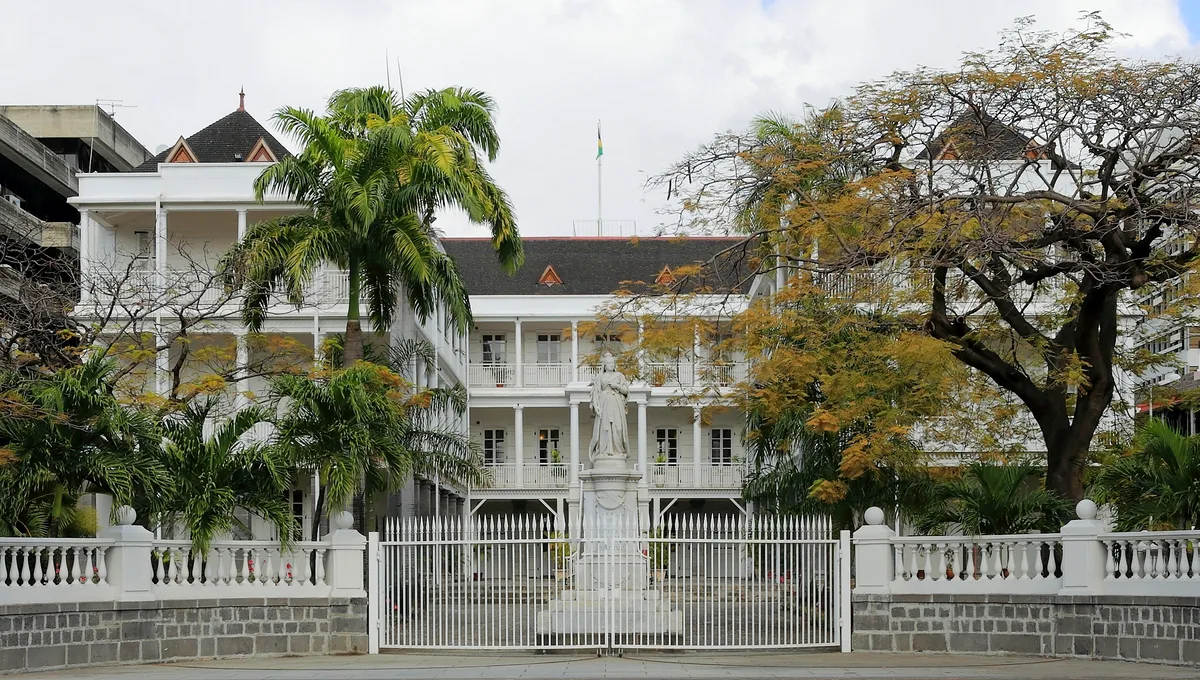
Sources: 2026-2027 Budget Speech and annex (19 June 2026), Economic and Financial Measures (Miscellaneous Provisions) Act 2026 (Act 13 of 2026) and Finance Act 2026 (Act 14 of 2026), assented to on 12 August 2026, Government Gazette No. 59 of 13 August 2026; EDB Golden Visa guide (August 2026). Banner photo: Martin Falbisoner, CC BY-SA 4.0, Wikimedia Commons.