+33 9 8080 1114
 +230 5457 0712

The essentials in 30 seconds
- Two public schools: the François-Mitterrand national conservatoire (Quatre-Bornes and six branches) and the Mahatma Gandhi Institute for Indian music.
- Almost free: at the conservatoire, lessons are free; you pay an annual enrolment fee, Rs 1,800 (€35) for the junior programme.
- A tight calendar: forms from 1 May, applications before the end of June, tests in July, enrolment in August. If you arrive in September, your child often has to wait until the following year.
- Exams recognised elsewhere: Trinity College London, London College of Music, and ABRSM theory from 2027. Useful if you ever move on.
- Private tuition takes over all year round, but no school publishes its fees: ask for them in writing.
Two state schools, almost free
In Mauritius, music is not only learned in private schools. Two public institutions teach thousands of children for a few thousand rupees a year. One mainly teaches Western and Creole music, the other Indian music.
| Conservatoire | MGI | |
|---|---|---|
| Music | Classical, jazz, pop, Creole, Indian | Indian |
| Age | From age 6 | Ages 6 to 9 |
| When | Weekdays after 3pm, and Saturday | Saturday morning |
| Price per year | From Rs 1,800 (€35) | Rs 500 (€9.70) |
| Application | Before the end of June | Before mid-January |
Conservatoire National de Musique François-Mitterrand, 2026-2027 form; Mahatma Gandhi Institute, notice of 28 November 2025. Prices: annual enrolment fees; at the MGI, Rs 375 (€7.28) for lessons and Rs 125 (€2.43) for registration.
Good to know
Neither form says whether a foreign child can enrol. The conservatoire asks for a birth certificate or an identity card; the Mahatma Gandhi Institute asks for a national identity card. Ask in writing before counting on a place.
The François-Mitterrand Conservatoire
The Conservatoire National de Musique François-Mitterrand is a public body under the Ministry of Arts and Culture. Its head office is on Avenue Mgr Murphy in Quatre-Bornes. According to its website, it has around 1,500 students a year and more than 1,000 instruments. Classes are held in Quatre-Bornes, Curepipe, Grand Baie, Port-Louis, Flacq, Plaine Magnien and Rodrigues.
- Musical awakening, from age 6: a first introduction to music, with no test;
- Junior programme, ages 8 to 10: keyboard, guitar, recorder, percussion, violin, choir, dance or drama, with no test except for the choir;
- Formal classes, from age 8: violin, viola, cello, double bass, guitar, piano, flute, clarinet, saxophone, trumpet, horn, trombone, organ, percussion... in cycles of 3 to 5 years, with compulsory music theory. Aptitude test for violin, viola, cello, guitar and piano;
- Jazz and pop: electric guitar, bass, drums, jazz piano... with at least 2 years of practice;
- Group classes, from age 8: Creole music (ravanne, djembe, Rodrigues drum), tabla, sitar, junior orchestra, brass band, accordion;
- Holiday courses, ages 6 to 20, and a programme for children with special needs, from age 8.
Classical singing, pop and musical theatre only start at 18. Classes run from Monday to Friday, 3pm to 8pm, and on Saturdays from 8.30am to 3pm, from 30 minutes to 2 hours a week depending on the level.
| Option | Per year |
|---|---|
| Junior programme (ages 6-10) | Rs 1,800 (€35) |
| 1st cycle | Rs 2,400 (€47) |
| 2nd cycle | Rs 3,000 (€58) |
| 3rd cycle | Rs 3,600 (€70) |
| Leisure, under 18 | Rs 3,000 (€58) |
| Holiday course | Rs 1,800 (€35) per period |
Annual registration fees, non-refundable. The classes themselves are free. Conservatoire 2026-2027 form, euro amounts at the rate of 25 November 2026.
Our advice
The conservatoire's form asks that the student has their own instrument or regular access to one. Allow for it in your luggage or your settling-in budget.
Enrolling: the deadlines not to miss
The conservatoire recruits once a year. Here are the dates for 2026-2027, taken from its application form:
-
1
From 1 May
The forms are online on the conservatoire's website.
-
2
Before 22 June, 5.30pm
Send by email, by post or drop it in the box at the head office in Quatre-Bornes.
-
3
20 to 22 July
Aptitude tests, for the classes that require them.
-
4
10 to 14 August
Registration and payment at the head office, with an ID photo and the birth certificate.
Good to know
A family arriving in September or January will have missed that year's intake. If music matters to your child, prepare the application before you leave, or plan for private lessons in the meantime.
At the Mahatma Gandhi Institute, the calendar is different: for the 2026 Saturday classes, applications were made online before 16 January 2026, and the institute reserves the right to cancel a class if too few students enrol.
Indian music at the Mahatma Gandhi Institute
The Mahatma Gandhi Institute, created by an act of 1970, teaches Indian music and dance. Its children's courses take place on Saturday mornings and are for ages 6 to 9.
- Moka: tabla, mridangam, Hindustani violin, Hindustani and Carnatic singing;
- Nouvelle-France and Ilot: tabla, Hindustani violin, Hindustani vocals;
- Solférino and Flacq: tabla, Hindustani vocals.
A course lasts 2 years at one hour a week, or 3 years for the violin. It costs Rs 125 (€2.43) to enrol and Rs 375 (€7.28) a year. From the age of 11, with the Mauritian end-of-primary certificate (PSAC or CPE), a 3-year certificate takes over: Rs 500 (€9.70) a year for the 2025 school year.
Exams recognised outside Mauritius
For a family on the move, a music qualification that follows the child from one country to another is worth its weight in gold. Several British bodies hold their graded exams in Mauritius.
- Trinity College London: music and rock & pop grades in digital format, which can be taken at any time; the local representative is the Ebanez Music school in Quatre-Bornes;
- London College of Music: the national conservatoire is an exam centre and prepares its students for the exams;
- ABRSM: the Mauritius Examinations Syndicate has been approved for music theory, grades 6 to 8, from 2027 (notice of October 2026);
- Cambridge: music is offered as a subject at School Certificate and HSC level, and the conservatoire runs a course to prepare for it.
Our advice
If your child has already taken grades in Europe, bring their certificates: the conservatoire's form asks for a copy of the certificates for a student who already plays.
Private lessons, workshops and séga
Private schools teach all year round and prepare students for the same exams: for example Ebanez Music in Quatre-Bornes (piano, guitar, violin, drums, Hindustani vocals) or Artvia in Calebasses, in the north (piano, singing, guitar, violin, theory). None of them publishes its fees or minimum age. The Institut français de Maurice also runs workshops, including singing, on a programme that changes with the seasons.
Our advice
Before committing, ask in writing for the price per lesson and per term, the teacher's qualification and the exam being targeted. Compare with the conservatoire's fees: the gap is often wide.
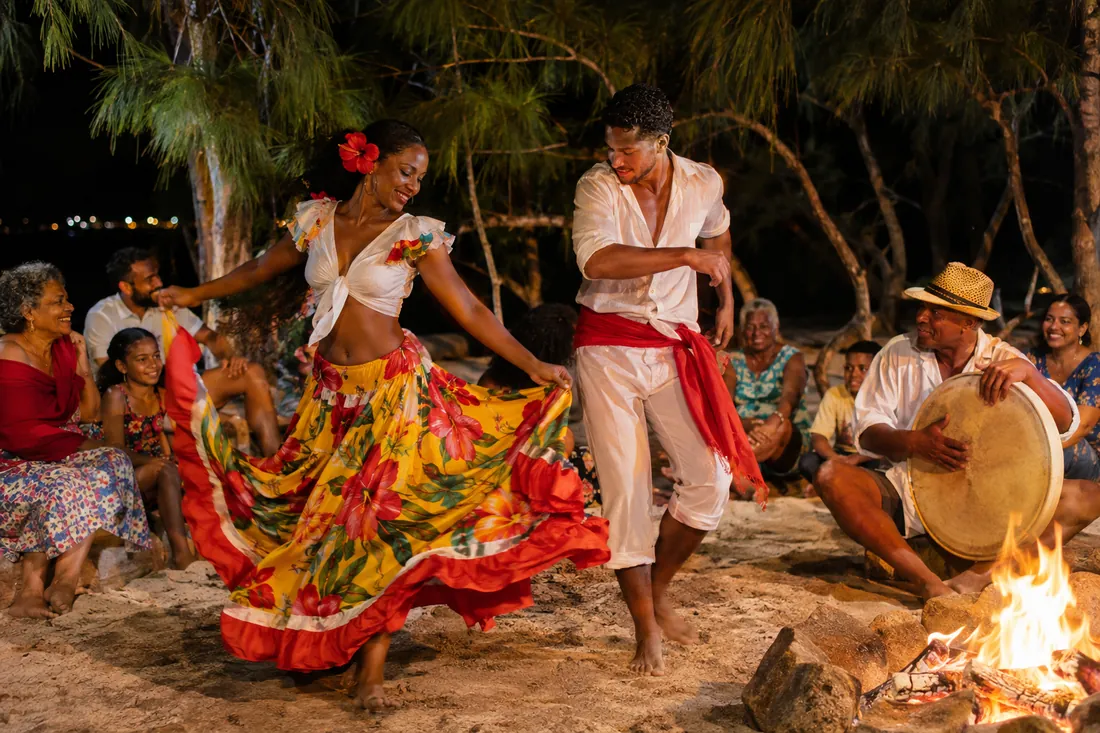
The island's music is well worth a detour. UNESCO added the traditional Mauritian séga in 2014, the Bhojpuri Geet-Gawai songs in 2016 and the Rodrigues séga tambour in 2017 to its list of the intangible heritage of humanity. To hear it with your family, our festivals page gives the dates.
Festivals and family celebrations
Preparing your move with children? We compare schools according to your address and handle the enrolment, taking into account the activities that matter to them.
Sources: Conservatoire National de Musique François-Mitterrand: 2026-2027 application form (May 2026), Presentation, Registration fees and Examinations pages on conservatoire.govmu.org; Mahatma Gandhi Institute: notices for children's courses (28 November 2025) and for the Certificate in Performing Arts (March 2025); Trinity College London (Mauritius page); London College of Music Examinations (Mauritius page); Mauritius Examinations Syndicate (ABRSM notice, October 2026); UNESCO (intangible cultural heritage, Mauritius); Institut français de Maurice; websites of Ebanez Music and Artvia. Read in November 2026.