 +33 9 8080 1114
 +230 5457 0712


The essentials in 30 seconds
- It is possible, with an import permit obtained before boarding, one per animal. Without it, the animal cannot travel.
- Quarantine is compulsory: 5 days at the Réduit centre for an animal travelling from France.
- The delay that worries people is rabies: officially, 3 months between the blood test and shipping. It is often possible to go faster: let's talk before you give up on your date.
- The animal travels alone, as cargo, and an agent must be waiting for it at the airport.
- Your own file matters: an expatriate must provide a copy of their residence or work permit.
- Dogs and cats must be neutered, unless intended for breeding. Certain dog breeds are refused.
- The budget: €2,000 at the very least for everything. Better to know from the start.
Can you bring your pet?
Yes. But Mauritius protects its territory against rabies and other diseases, and every condition must be met by the set date. Your pet faces four main stages.
-
1
Health
Vaccinations, blood tests and neutering, within set deadlines.
-
2
The permit
It is issued by the Veterinary Services Division of the Ministry of Agro-Industry.
-
3
The journey
As cargo only, with an agent present on arrival.
-
4
Quarantine
At the Réduit centre, before you are reunited.
The difficulty lies mostly in the dates: each vaccination and each test is calculated from the animal's arrival date. Done too early or too late, or with an incomplete document, they can cost several months, sometimes a new vaccination and new tests.
This article covers dogs and cats. For a rabbit or another animal, the rules and quarantine length are different.
How long does quarantine last?
For an animal travelling from France, the regulations require 5 days at the Réduit quarantine centre. From a country with a poorer rabies situation, the length can go up to 1 month.
- A place to book: the permit depends on a kennel being available at the centre. Capacity can therefore decide your arrival date.
- Year-end closure: the centre is announced as closed from 19 December 2026 to 5 January 2027.
- Food: you pay for it, as well as litter for a cat.
- Visits: Monday to Saturday from 9am to 11am and from 1pm to 2.30pm, Sundays and public holidays from 9am to 12 noon.
- Collection: you come to collect your pet, or a person you have authorised in writing.
Our advice
Quarantine itself is short, and you can visit your pet. The trickier part comes before: an arrival date that moves can put the tests and the place at the centre in question.
Vaccinations and tests: what is required

| The requirement | What you need to know |
|---|---|
| Rabies serology | Officially: a blood test 4 weeks after the vaccine, with a result of at least 0.5 IU/ml, then a 3-month wait before shipping. |
| Dog vaccines | Distemper, hepatitis, leptospirosis, parvovirus: up to date, and given no less than 2 weeks before departure. |
| Cat vaccines | Feline panleukopenia, cat flu (rhinotracheitis and calicivirus): up to date, and given at least 2 weeks before departure. |
| Dog tests | Negative ehrlichiosis test within 45 days before departure, and negative Brucella canis test. Cats are not affected. |
| Sterilisation | Certificate signed and stamped by the vet, except for an animal intended for breeding. |
| Microchip | Its number must appear on the laboratory results. |
Good to know
Below 0.5 IU/ml, the result is not accepted: you must revaccinate and start again.
Our advice
These timeframes are the official rule. In practice, things can often move faster. Give us your arrival date: we will look at what is possible for your pet.
That is the whole headache: rabies requires starting very early, while ehrlichiosis is tested at the last moment. If departure slips, some results may no longer be valid. On top of this, the results and the international health certificate must be endorsed by the official authority of the country of departure.
Age matters too: a puppy or kitten cannot arrive very young, since it must first be vaccinated, tested and sterilised.

Which dog breeds are banned?
Check this before spending anything. Mauritius distinguishes between refused breeds and those classed as dangerous by the Animal Welfare Act 2013, which are admitted only if purebred.
9 refused breeds
- American Pit Bull Terrier
- American Staffordshire Terrier
- Staffordshire Terrier
- Blue Nose Pit Bull
- Red Nose Pit Bull
- Japanese Tosa
- Dogo Argentino
- Fila Brasileiro
- Boerboel
They cannot enter.
9 conditional breeds
- Alaskan Malamute
- Bull Mastiff
- Cane Corso
- Dobermann
- Kangal
- Mastino Napoletano
- Presa Canario
- Rhodesian Ridgeback
- Rottweiler
A crossbreed of these breeds is not admitted.
Does your dog look like one of these breeds, but you have no breed papers? Ask before you start the tests.
The import permit and your file
No animal may board for Mauritius without this permit, issued by the Veterinary Services Division. You need one per animal, and it must be in hand before departure.
- It comes at the very end: the application relies on the vaccinations and tests already done.
- The timeframe: allow at least 10 to 15 working days once the file is complete, based on our 2026 cases.
- A short validity: the permit covers around 30 days around the arrival date. Once you have it, the journey must follow.
- The flight: book it only after the permit and the quarantine place are confirmed.
- Format matters: files must be in English, and the ministry may reject a document that is illegible or unstamped.
One point often comes as a surprise: your animal's file depends on yours. An expatriate must provide a copy of their residence or work permit. If your permit has not yet been started, that is where you need to begin.

Travelling as cargo with your pet
Animals enter Mauritius only as declared freight, without exception: not in the cabin, nor in the hold as excess baggage. Your animal therefore travels separately, even if you take the same flight.
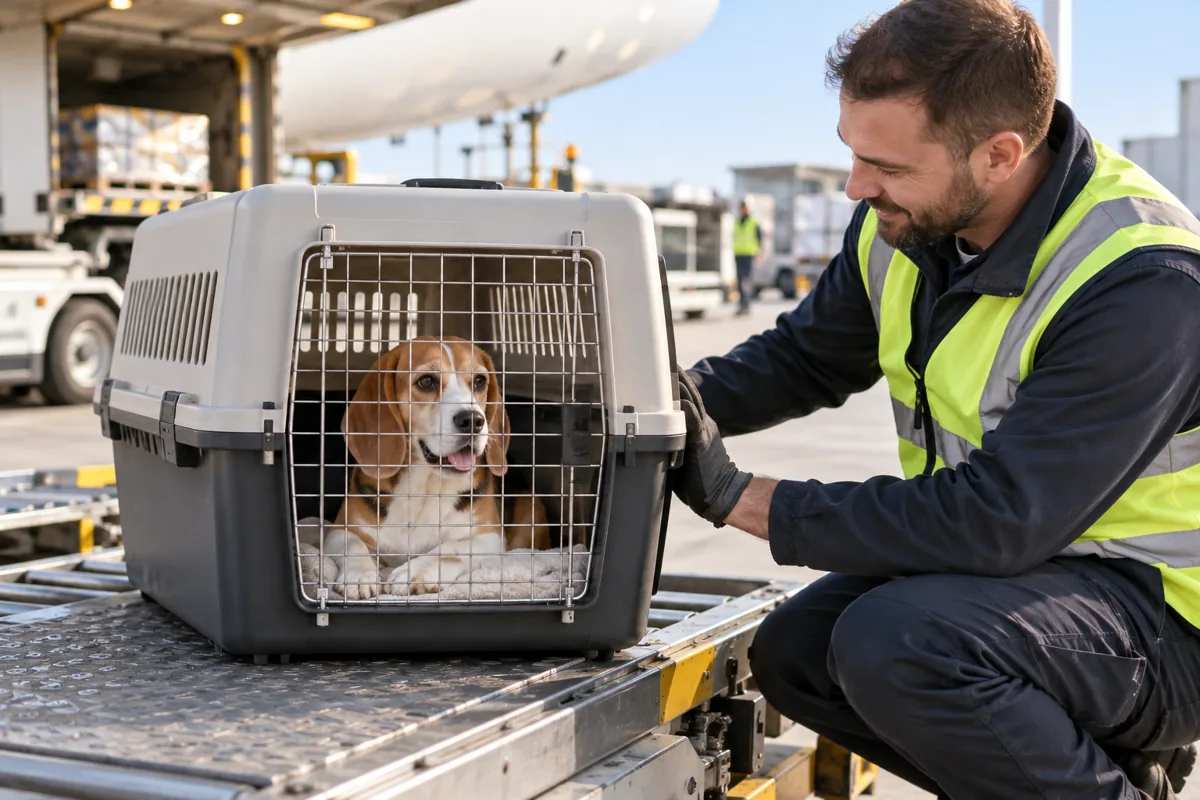
- An agent on arrival: their contact details are required for the permit. If they are not at the airport, the animal may be sent back by air, at your expense.
- Advance notice: the flight number and arrival time must be sent at least 4 days beforehand.
- The originals: they travel with the animal, along with the international health certificate. One missing document can stop everything.
- Departing from Mayotte or an overseas territory: transport options are far scarcer. Sort this out from the start.
How much does it cost to bring your pet?
Allow €2,000 at the very least, for everything: our support, the vet and tests, the transport crate, the cargo flight, customs clearance and quarantine.
- The cargo flight: this is the biggest item. It is priced by quote, based on the weight and volume of the crate, and so on the size of your animal.
- The vet and the laboratory: the amount depends on what has already been done, such as vaccinations or sterilisation.
- A test to repeat: an unexpected expense, which a well-prepared file avoids.
This amount often comes as a surprise. It is better to know at the start of the project, before the first expenses.
What makes an application fail
What we see with our clients
The same pitfalls keep coming up: a serology result that is too low, forcing you to redo the vaccination and test; a sterilisation certificate without a stamp; PDFs that are too compressed and rejected by the ministry; a file stuck for several weeks because the owner's permit had not yet been submitted; a dog test to redo at the last minute; a budget discovered too late.
Once your pet is with you, you still need to register your dog with the Mauritius Society for Animal Welfare and check that your home accepts it. Say so from the start of your search: not every landlord agrees, and a garden makes a big difference to a dog.
To avoid these pitfalls, we take the file in hand: we calculate the dates from your arrival, check the documents, then put you in touch with the right people.
Sources: Rules of the Mauritius Veterinary Services Division, Animal Welfare Act 2013, and our import files from 2026.