+33 9 8080 1114
 +230 5457 0712


The essentials in 30 seconds
- Investing in Mauritius is not dangerous in itself: the framework is written down, and the law regulates off-plan purchases. Almost all the real risks can be checked before you sign.
- Danger no. 1 is buying outside the rules: a foreigner cannot buy just anything, and the sale can be cancelled.
- Off plan, check the developer and its guarantee: a major Mauritian developer was placed under judicial administration in May 2026.
- On the seafront, look at erosion and flooding: official maps exist.
- Do your sums: around 5.8% in purchase costs, a resale taxed at 5%, and a yield never guaranteed by law.
Is it dangerous to invest in Mauritius?
Be careful, but don't panic. Foreigners invested around €400 million in Mauritian property in 2025, a large share of it in the schemes designed for them. The market is governed by clear rules that you can read and check. Bad surprises almost always come from a point that was not checked before signing.
| The danger | How to avoid it |
|---|---|
| Buying outside the rules | Check that the property belongs to an authorised scheme |
| A developer who doesn't finish | Insist on a written completion guarantee, and pay according to progress |
| A hidden title issue or charges | Run mortgage searches, and ask the managing agent about unpaid charges |
| The sea and water | Look at the official maps and the real distance to the sea |
| Figures that look too good | Count all the costs, and be wary of promised yields |
Are you buying to let? The yield also depends on what happens once you have the keys. If you live far away, someone has to find tenants, oversee maintenance and report back to you: we can do that, with a report every month.
What can a foreigner buy?
This is the first point to check. A non-citizen cannot buy freely in Mauritius: unless exempt, they need a certificate from the Minister. In practice, foreigners go through these routes.
| The route | Who it is for, at what price |
|---|---|
| PDS, IRS, RES, Smart City | Any foreigner, through the scheme's company. No minimum price under PDS. Permit from $375,000. |
| G+2 apartment | Building of at least 2 floors above the ground floor, from Rs 6 million (about $128,000), subject to authorisation. Permit from $375,000. |
| Residential property outside the schemes | For someone already resident in Mauritius, a single property to live in, from $500,000, subject to the Minister's approval. No right to a permit. |
Non-Citizens (Property Restriction) Act, Immigration Act 2022 and EDB guidelines. The Rs 6 million (about $128,000) threshold may be changed by regulation.
Good to know
Outside this framework, the sale is void: the property is seized and sold, and what is left comes back to you after costs are deducted. On top of that come a fine of up to Rs 10,000 (about $210) and one year in prison. Setting up a company does not get around the rule: an unlisted company with just one foreign shareholder is treated as a foreigner. So be wary of any suggestion to go through a friend or a nominee, and ask a lawyer for advice.
Our advice
Before viewing a property "off plan under a PDS", look for the project on the EDB's public list. Check its status too: the "Letter of Approval" allows you to sign a preliminary contract, but the "PDS Certificate" is required before the sale.
What we see in applications
Buying in Mauritius can be tedious and very slow. Some notaries are unwilling to handle the permit application, and your file can then get stuck. And some buyers go for a purchase outside the framework without understanding that they will not really be residents.
Our advice
Before signing, ask two questions in writing: does this property entitle me to a residence permit, and who is handling the application?
If nobody is handling it, your file will not be left hanging: we check with you that the property qualifies, then put together your residence file and follow it through to the permit.
Buying off plan: the developer risk
This is the most serious risk, and it is not theoretical: in May 2026, a major Mauritian developer was placed under judicial administration, according to the notice published by the Stock Exchange of Mauritius. The law does give you real tools, though. You still have to use them.
- Nothing before signing: in an off-plan sale, the seller cannot demand any payment before the contract. Only the preliminary contract allows a deposit, paid into a special account in your name.
- The reservation deposit is capped at 25% if the sale takes place within the year, and 2% within two years. It is returned to you, in particular, if the price exceeds the agreed price by more than 5%.
- The completion guarantee: ask for the bank's letter. The Civil Code also allows a guarantee without a bank in some cases: read carefully which one appears in your contract.
- The bank guarantee of Rs 50,000 (about $1,100) per unit under a PDS is for the benefit of the EDB, not you. It does not replace the completion guarantee.
- The deadline: no legal scale of late-delivery penalties was found. Have the deadline and the penalties written into the contract.

The title, the charges, the permits
- Mortgages: the Conservator of Mortgages issues the searches and certificates. Ask for them, even if you are using a notary.
- Unpaid service charges: they can be secured by a mortgage on the unit. Also ask the managing agent for a written statement, with the annual budget.
- The co-ownership rules: they set your share of the charges, and may restrict letting. Read them before signing.
- The building permit and the certificate of conformity: works without a permit can lead as far as demolition, and a building cannot be occupied without a certificate.
- The estate agent: they must register with the Real Estate Agent Authority from 1 August 2026, with a transition period. The authority gives information from its register on 490 7801.
- A single contact is not enough: the seller and their agent are defending the sale price. Have the contract reviewed by someone who has nothing to gain from the sale.
After the purchase, the Civil Code protects you: the seller of a new home is liable for hidden defects for 10 years on the structural work and 2 years on minor works, including towards the next buyer. This guarantee is only worth something, however, if the person who owes it is still solvent.
Someone who has nothing to gain from the sale is precisely our role: we take no commission on transactions. We inspect the property, negotiate the price and review the contract on your side.
Erosion, flooding and cyclones
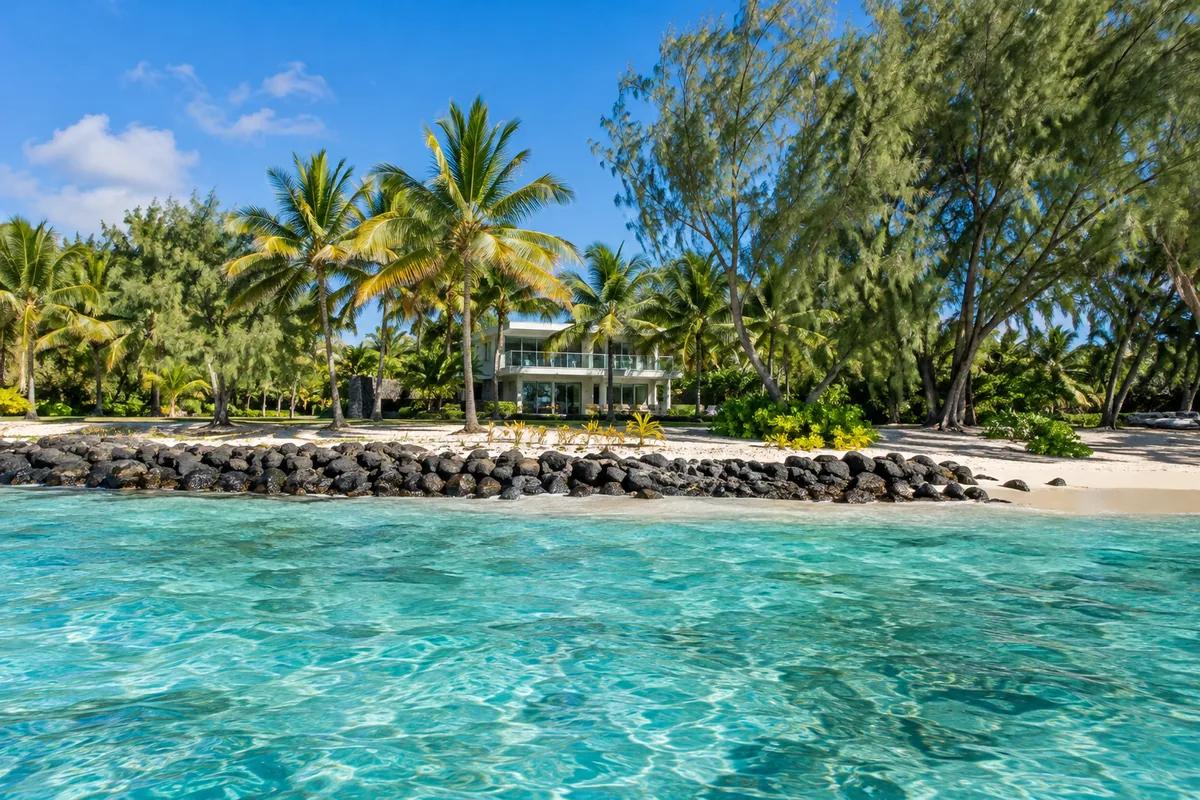
- Erosion: according to the government, more than 37 km of coastline is affected. Sites to be rehabilitated include Trou aux Biches, Grand-Baie, Mon Choisy, Bain Bœuf, Bel Ombre and Blue Bay. A plan worth Rs 4 (about $0) billion has been announced for 2026-2027.
- The setback: the official building permit guide asks for 30 m from the high-water mark. Older buildings may stand closer.
- The beach remains public: no beach in Mauritius is private, and the Pas Géométriques strip belongs to the State. Check whether the land is freehold or only a lease.
- Flooding: the official 2025 plan names 16 high-risk sites, including Grand Baie-Pereybère, Flic en Flac, Bel Ombre, Mapou and Quatre Bornes, and classes 15.5% of the territory as areas to protect or not to extend. These are regions, not plots: look at the Land Drainage Authority maps.
- Cyclones: the home insurance policies we have read cover both cyclone and flood damage. Ask for a quote, and read the excesses and exclusions.
Our advice
For a specific property, ask for the map of the area, and ask the neighbours about the last heavy rain. A visit after a heavy downpour will tell you more than a nice photo.
Fees, rents and resale: do the sums
- Resale: the seller pays 5% tax, and the buyer 5% duty. On the round trip, you should therefore count on more than 10% of the price before any capital gain.
- Capital gains: there is no specific tax in Mauritius for an individual, unless you are in the business of buying and reselling. On the French side, have your case confirmed by a tax adviser.
- Rents: 15% tax in Mauritius for a non-resident, on income after expenses. For a French resident, they are not taxed in France, but they count when working out the rate on your other income.
- The rupee: it has lost about 8% against the euro in five years. That is an advantage when you buy in euros, a loss if your rents stay in rupees.
- Repatriation: Mauritius has had no exchange controls since 1994. You can transfer the sale price and the rents out once the taxes are paid.
Good to know
There is no official rental yield figure: private estimates range from about 3 to 6% gross, before costs, management and tax. The EDB guidelines do not regulate the "guaranteed" yields promised by some sellers. Ask who guarantees them, for how long, and what happens if that company disappears.
Prices have risen sharply: the official index more than doubled between 2021 and 2025. The rise has, however, almost stopped, with +0.4% over one year in the second quarter of 2026. Do not buy counting on the same growth.
For financing, do not count on a Mauritian loan: under the PDS, the principle is to pay from abroad, and a local loan is only provided for very large amounts. If a bank tells you otherwise, ask it for a written answer for the programme you have in mind.
The permit, resale and inheritance
- The permit depends on the property: it lasts as long as you own it. If you sell, you may lose your resident status, and your family may lose theirs too. Think about this before reselling.
- Two of you buying at $375,000: one is the holder, the other is attached as spouse. Each has an individual right only if their share reaches $375,000.
- Notify the EDB at least 30 days before the sale. The foreign buyer files their own application.
- Inheritance: property in Mauritius follows Mauritian law, even when owned by a foreigner, with a reserved share for children. Have your situation reviewed by a Mauritian notary, as the Code also provides a reciprocity rule for foreign heirs.
Sources: Non-Citizens (Property Restriction) Act, Immigration Act 2022, Mauritian Civil Code, Real Estate Agent Authority Act 2020, Finance Act 2026, Income Tax Act and Registration Duty Act (MRA), EDB guidelines and lists, France-Mauritius tax treaty, Land Drainage Master Plan (2025), NDC 3.0 climate contribution, 2026-2027 budget speech, Bank of Mauritius, Statistics Mauritius, Stock Exchange of Mauritius. Read in November 2026.