+33 9 8080 1114
 +230 5457 0712

The essentials in 30 seconds
- Leave with a stock a little longer than planned and a prescription under the name of the molecule: that is the advice of the French diplomatic service.
- At customs, your medicines go through with a valid prescription. Tramadol, anxiolytics, sleeping pills and strong codeine also require authorisation from the Ministry of Health.
- Diabetes and high blood pressure are common in Mauritius: the public hospital system has a diabetes centre in Souillac, and public dialysis is free according to the ministry.
- Since September 2024, gluten, peanuts, milk, eggs, fish, crustaceans, tree nuts, soya and sulphites must appear on the label of packaged foods.
- The CFE asks no questions about your health and cannot exclude you. Join before you leave to avoid the waiting period.
Before you leave: stock and prescription
The French diplomatic service gives people on treatment a simple rule: ask your doctor for a stock slightly longer than the length of your stay, because the import of certain medicines is restricted. If you are moving, plan enough to last until you find a doctor on the spot.
- A prescription using the international name (INN), that is, the name of the molecule: in Mauritius, the brand name is often different;
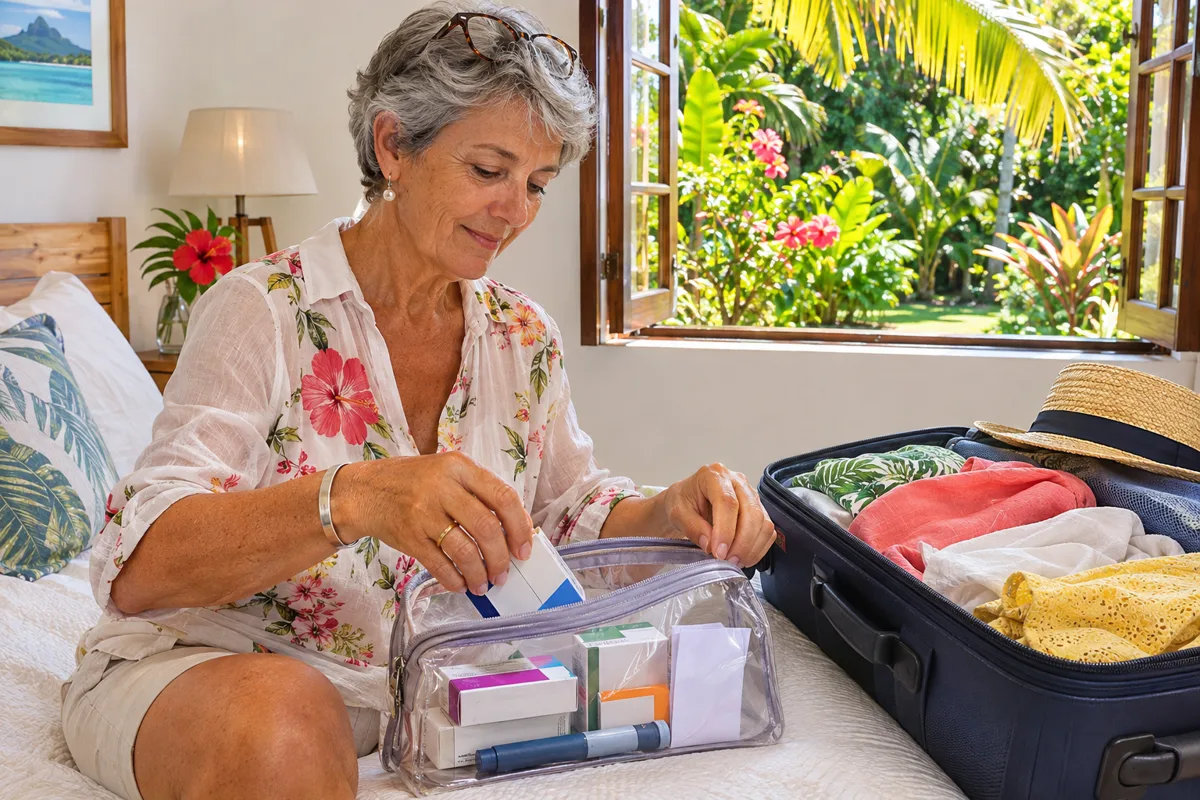
- The original boxes, with their labels, in your hand luggage;
- A report from your doctor: your illnesses, your treatments, your allergies. The Mauritian doctor will save time;
- Your latest tests: blood tests, reports, letters from specialists.
For the residence permit, you will have a medical examination. It looks for a communicable disease: diabetes, high blood pressure, cancer or long-term treatment are not cited as grounds for refusal in any of the texts we have read. Tell the doctor, who will note them in your medical history.
Your medicines at customs
Mauritian customs lets in the medicines of a traveller on treatment, with a valid prescription from a doctor. No quantity limit is published. But the drugs law classes several medicines common in France among controlled products.
| Medicine | Rule |
|---|---|
| Blood pressure, diabetes, heart, asthma | With a prescription |
| Tramadol, strong codeine | Ministry authorisation |
| Xanax, Lexomil, Valium | Ministry authorisation |
| Sleeping pills (zolpidem) | Ministry authorisation |
| Cannabis, Ritalin | Banned |
Dangerous Drugs Act 2000 and customs FAQ (MRA). Small doses of codeine in combination products are exempt. Authorisation is requested from the Ministry of Health before the trip.
Good to know
Customs has already seized tramadol and pregabalin from travellers without a prescription or authorisation. A controlled treatment cannot be slipped into a suitcase: request authorisation before you leave.
A condition very common in Mauritius
You won't be an exception. The Ministry of Health's latest major survey, in 2021, found type 2 diabetes in 19.9% of adults aged 25 to 74, and high blood pressure in 27.2%. A quarter of diabetics did not know they had it. Asthma affects 7.5% of adults.
As a result, the health system knows these conditions well. Pharmacies sell diabetes and blood pressure treatments, and since 1 February 2026 the State pays Rs 50 (about €1) per box on these medicines when the box costs at least Rs 100 (about €2).
In a public hospital
- A diabetes and vascular centre at Souillac hospital, since 2010: diabetologist, foot care, nutritionist.
- Screening for diabetes-related eye damage in the 5 regions.
- Dialysis in 7 public hospitals, free for public patients according to the ministry (2021 figures).
- The texts we read do not say whether a foreigner can use it free of charge: ask.
For regular follow-up, if the waiting doesn't bother you.
In a clinic or a private practice
- Endocrinologists, nephrologists and pulmonologists registered with the Medical Council.
- Some private clinics offer dialysis: six in 2021 according to the ministry, and Artemis Cascavelle since September 2026.
- Everything is paid for: check what your insurance reimburses.
To keep the same doctor and be seen quickly.
Finding your doctor
Start with a general practitioner: they renew prescriptions and point you in the right direction. For a specialist, ask your GP or other expats for a name, then check it.

The Medical Council list of specialists can be sorted by specialty. Search for "Endocrinology" for diabetes, "Nephrology" for the kidneys, "Pulmonology" or "Respiratory Medicine" for asthma, "Dermatology" for the skin. If the name isn't there, the person is not registered as a specialist in Mauritius.
Good to know
On 21 November 2026, allergology was not among the 134 specialties on the list. For an allergy, see a GP, a pulmonologist, a dermatologist or an ENT specialist depending on your symptoms.
-
1
The first month
A GP near your home, with your medical file and your boxes of medicine.
-
2
Before the last box
Have the prescription renewed locally, without waiting until you run out.
-
3
Follow-up care
The tests your doctor prescribes, in the same place if possible.
Our advice
Always keep a month of treatment in reserve. In cyclone season, from 1 November to 15 May, medicines are part of the kit to prepare: a cut-off road or a pharmacy closed for two days must not interrupt a treatment.
A food allergy
Since 9 September 2024, the Mauritian food regulations require packaged foods to show on the label any ingredients that can cause an allergy. The label must be in English or French.
- Gluten: wheat, rye, barley, oats, spelt;
- Crustaceans and fish;
- Eggs and milk, including lactose;
- Peanuts and soya;
- Tree nuts;
- Sulphites, from 10 mg per kilo.

In restaurants, at the market or from a caterer, it is a different story: we have not read any rule requiring allergens to be listed for a dish. Tell them about your allergy with every order, clearly, and ask what the dish contains.
Our advice
Prepare a small card in English and French: "I am allergic to… / Je suis allergique à…", with the name of the food. It travels from hand to hand all the way to the kitchen better than a quick explanation.
Good to know
A severe reaction, swelling of the face or difficulty breathing: call 114, the SAMU. If you have adrenaline pens, take them with the prescription, in your hand luggage.
Insurance when you are already ill
This is the point that matters most. No social security agreement links France and Mauritius: on the island, your treatment is paid for by the insurance you have chosen. The French diplomatic service considers insurance covering all medical costs essential.
- The CFE, the Caisse des Français de l'étranger, asks for no health questionnaire, whatever your age, and cannot exclude you once you have joined;
- Join before you leave or within 3 months of settling in: your care is covered straight away;
- Later, a waiting period applies: 3 months if you are under 44, 6 months if you are over 45, according to the CFE;
- Reimbursement depends on the country and the type of care, as a percentage or a flat amount of the actual expense;
- The CFE alone covers neither medical evacuation nor repatriation: you need an option or an assistance insurance policy.
Good to know
A private insurer, on the other hand, may ask questions about your health. Before signing, read the clause on conditions known before joining: excluded, covered after a waiting period, or covered with a surcharge.
Are you preparing your retirement in Mauritius while on ongoing treatment? We put together your residence permit application and tell you which clinics carry out the tests for the certificate.

Sources: diplomatie.gouv.fr (Mauritius, health, 15 September 2026); MRA (customs FAQ, press release of 14 January 2026, seizures of 2017 and 2018); Dangerous Drugs Act 2000; Ministry of Health: Mauritius Non Communicable Diseases Survey 2021, Hospital Services page (dialysis, Diabetes and Vascular Health Centre); Food Regulations 2024 (GN 142 of 2024, regulation 4); Medical Council of Mauritius (list of specialists); Artemis; CFE (MondExpat, JeunExpat and SeniorExpat offers). Read in November 2026.